




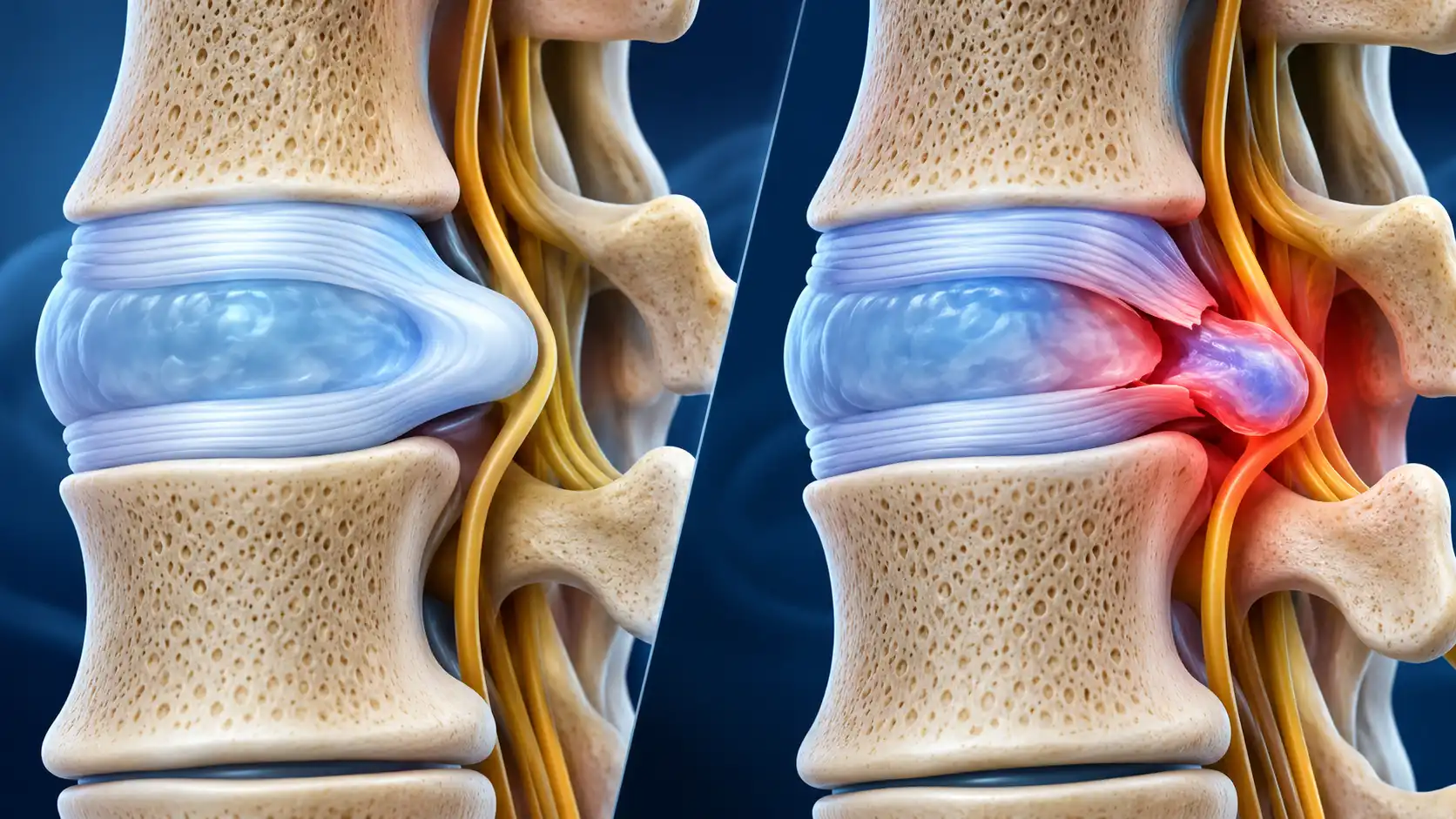
Herniated disc versus bulging disc comes down to how the spinal disc changes shape. A bulging disc extends outward over a broad area, while a herniated disc involves a more localized displacement of disc material. Both conditions can irritate nearby nerves, but neither automatically means severe pain or surgery.
If an MRI report or a doctor has just handed you one of these terms, you're probably more worried than you need to be. Both problems are common, both involve the cushions between your spinal bones, and plenty of people recover well without surgery. This guide covers what each condition is, how it feels, how it's diagnosed, and what actually helps.
How Your Spinal Discs Work
Your spine is a tall stack of small bones called vertebrae, and between almost every pair sits a disc. The easiest way to picture one is a jelly-filled donut. The outside is a tough, layered ring called the annulus fibrosus. The inside is a soft, gel-like center called the nucleus pulposus. Together they soak up shock every time you walk, lift, cough, or jump, and they let your back bend and twist without bone grinding on bone.
Here's the catch. Discs have very little direct blood supply, so they have a limited ability to repair themselves. As we age, they gradually lose water, become stiffer and flatter, and may become more vulnerable to damage. That's why disc trouble often shows up in the lower back (lumbar spine) and neck (cervical spine). These areas experience substantial movement and mechanical stress.
What Is a Bulging Disc?
A bulging disc happens when disc tissue extends outward beyond the normal edges of the vertebrae over a relatively broad area. Picture a tire bulging at the sidewall or a burger squeezed into a bun that's too small. Unlike a localized herniation, a bulge generally involves a wider portion of the disc's circumference.
Bulges commonly develop gradually as spinal discs undergo age-related changes. Here's what surprises most people: a bulge is often silent. Imaging studies of adults with no back pain regularly identify bulging discs, and these findings become more common with age.
A systematic review published in the American Journal of Neuroradiology found that disc bulges were present in approximately 30% of asymptomatic 20-year-olds and 84% of asymptomatic 80-year-olds. These findings show why a disc bulge on an MRI doesn't automatically explain someone's pain. You can explore the findings in this peer-reviewed study on spinal degeneration in people without symptoms.
When a bulge does hurt, it may be because it irritates nearby tissues or places pressure on a nerve root. Depending on the location and severity, symptoms can range from a dull ache and stiffness to radiating pain, tingling, or weakness.
What Is a Herniated Disc?
A herniated disc occurs when disc material extends beyond its normal boundaries in a more localized area. This can happen when the outer annulus weakens or develops a tear, allowing internal disc material to move outward. You'll also hear this called a ruptured or prolapsed disc.
Unlike a broad-based bulge, a herniation typically affects a more concentrated section of the disc. Medical professionals may describe different forms of herniation, including protrusion, extrusion, and sequestration, depending on the shape and position of the displaced material.
That displaced material matters for more than physical pressure. Disc material can also contribute to inflammation around nearby nerve roots. Even a relatively small herniation may cause significant symptoms if it affects a sensitive nerve.
In the lower back, a herniation near a nerve root can cause sciatica, a pain that travels from the buttock down the leg, sometimes all the way to the foot. In the neck, it can send pain, tingling, or weakness into the shoulder, arm, and hand.
Herniations frequently affect adults in their working years, although they can occur at different ages. The two lowest lumbar disc levels, L4-L5 and L5-S1, are common locations. Symptoms may develop gradually or appear after lifting, twisting, or another movement that places stress on the spine.
Herniated Disc Versus Bulging Disc: A Side-by-Side Comparison
Here's a quick look at how the two conditions stack up.
| Feature | Bulging Disc | Herniated Disc |
|---|---|---|
| Disc shape | Broad outward extension | More localized displacement |
| Outer wall | Often associated with stretching or degeneration | May involve annular weakening or tearing |
| Inner material | Generally remains within the disc's outer boundaries | May protrude or move through damaged outer layers |
| Area affected | Wider section of the disc | More concentrated area |
| Nerve irritation | Possible, but often absent | Possible, depending on location |
| Typical symptoms | None, stiffness, back pain, or nerve symptoms | None, local pain, radiating pain, numbness, or weakness |
| Common causes | Aging, degeneration, repeated mechanical stress | Degeneration, strain, or injury |
| Usual first treatment | Conservative care | Conservative care |
| Recovery | Varies with symptoms and severity | Varies; many improve over weeks to months |
The biggest difference between a bulging disc and a herniated disc is the shape and extent of the displaced tissue, not simply how much pain a person experiences.
Think of these conditions as related but distinct changes in a spinal disc. Some bulges can coexist with herniations, and degeneration may contribute to both. However, a bulging disc does not necessarily turn into a herniated disc.
Most importantly, imaging findings alone cannot determine how serious someone's symptoms will be. A broad bulge may cause substantial nerve compression, while a small herniation may cause no symptoms at all.
Slipped Disk vs Herniated Disk: Clearing Up the Confusion
"Slipped disc" might be the most popular back-pain term in the world, and it's also a bit misleading. Discs don't literally slip. They're firmly attached to the vertebrae above and below, so nothing slides out of place like a book falling off a shelf.
What people usually mean by the phrase is a herniated disc, where disc material pushes outward beyond its usual boundaries.
Some people use the term loosely for bulges too, which is where the mix-up begins. The spelling adds another wrinkle. "Disc" and "disk" mean the same thing in this context, and the preferred spelling varies by publication and region.
According to Mayo Clinic's explanation of herniated disk symptoms and causes, a herniated disk is also commonly called a slipped or ruptured disk. It may irritate nearby nerves and cause pain, numbness, or weakness, although some people experience no symptoms.
So, if someone says they have a slipped disk, they are usually referring to a herniated disc. If an MRI report specifically identifies a bulge, that is a different description of the disc's shape.
Bulging Disc vs Herniated Disc: Symptoms to Watch For
Symptoms depend on where the problem sits and whether a nerve is involved. Neither condition guarantees pain.
Signs More Typical of a Bulging Disc
A dull ache or stiffness in the lower back or neck
Discomfort that worsens with prolonged sitting or bending
Tightness in nearby muscles
Occasional tingling when a nerve is irritated
Radiating pain if the bulge compresses a nerve
No symptoms at all
Signs More Typical of a Herniated Disc
Sharp, burning, or electric pain that travels into a leg or arm
Numbness or pins and needles in the foot, calf, hand, or fingers
Muscle weakness, such as a foot that catches or a weaker grip
Pain that worsens with coughing, sneezing, or straining
Lower back or neck pain that changes with body position
One helpful rule of thumb: pain that travels down an arm or leg, particularly when accompanied by tingling or weakness, may indicate nerve irritation.
However, symptoms alone cannot reliably distinguish a bulging disc from a herniated disc. Both conditions may produce similar symptoms, and other spinal problems can cause the same discomfort.
A physical examination is important for determining whether a spinal nerve is involved.
What Causes Disc Problems?
Most disc trouble is the result of gradual changes rather than one dramatic moment. Age-related degeneration is a major contributor, but several factors can increase the likelihood of disc problems.
Repetitive strain is one. Jobs that involve heavy lifting, frequent twisting, or prolonged vibration, such as driving, may increase mechanical stress on the spine. Long periods of sitting can also aggravate symptoms in some individuals.
Excess body weight can increase the load on the lumbar spine, while smoking may reduce the availability of nutrients needed for disc health.
Weak core muscles and poor overall conditioning may make it harder to tolerate everyday physical demands. Genetics also play a role, since some people are more susceptible to disc degeneration than others.
Sometimes a single event, such as a fall, car accident, or lifting a heavy object, contributes to a symptomatic disc injury. However, many people cannot identify one specific movement that caused their condition.
Herniated vs Bulging Disc: How Doctors Tell Them Apart
Diagnosis starts with a conversation and a physical exam. A clinician will ask where the pain travels, what makes it better or worse, and whether you've noticed numbness or weakness.
They'll check your reflexes, muscle strength, and sensation. They may also perform a straight-leg raise test, where lifting your leg while you lie down can reproduce symptoms associated with irritation of certain lumbar nerve roots.
If symptoms are severe, neurological deficits are present, or the condition doesn't improve as expected, imaging may be considered. An MRI is particularly useful because it shows soft tissue clearly, including discs, nerves, and the spinal canal.
What Is a Disc Protrusion?
A disc protrusion is a type of disc herniation in which displaced disc material extends beyond the normal disc boundary while maintaining a relatively broad connection to the original disc.
Medical reports may also use these terms:
Disc protrusion: A localized herniation in which the base of the displaced material is broader than its outward extension.
Disc extrusion: A herniation in which displaced material extends farther outward relative to the width of its connection to the disc, or loses continuity with the disc of origin.
Disc sequestration: A type of extrusion in which a fragment of disc material becomes separated from the original disc.
These terms describe the anatomical appearance of disc displacement. They do not automatically indicate how much pain someone will experience or whether surgery is required.
Can an MRI Tell Which Disc Condition Is Causing Pain?
An MRI can help identify whether a disc is bulging or herniated and whether nearby nerve structures appear compressed.
However, because bulges and even herniations can appear on scans of people with no pain, clinicians must interpret imaging alongside symptoms and examination findings.
Doctors treat the person, not just the picture. A disc abnormality becomes more clinically meaningful when its location matches the patient's symptoms and neurological findings.
Many people with concerning MRI terminology still improve with appropriate conservative care.
Treatment Options
The good news is that many people with bulging or herniated discs improve without surgery. Treatment generally starts with conservative approaches, with more invasive options considered when symptoms or neurological findings warrant them.
Stay Active, Within Comfort
Old advice to rest in bed for several days is generally no longer recommended for uncomplicated back pain.
Short walks, regular position changes, and a gradual return to daily activities can help maintain mobility and function.
Avoid pushing through severe or worsening nerve symptoms, and adjust activities according to professional guidance.
Ease the Pain Early
Heat or ice may provide temporary relief. Over-the-counter anti-inflammatory medication may help some people, provided it is safe for their individual health circumstances.
A healthcare professional may recommend other short-term medications when appropriate.
These approaches can help control symptoms while inflammation settles, but they do not directly reverse a disc bulge or herniation.
Get a Targeted Rehabilitation Plan
A physiotherapist or appropriately qualified chiropractor can assess movement limitations, identify aggravating activities, and recommend exercises that support recovery.
Rehabilitation may focus on improving mobility, strengthening the trunk and hips, restoring confidence with movement, and developing safer lifting habits.
For patients in Southfield, Michigan, CoreChiro Rehab's chiropractic care services include individualized assessments and treatment planning for musculoskeletal conditions such as back and neck pain. Depending on the diagnosis, manual treatment and rehabilitation exercises may form part of a broader care plan.
Treatment should be tailored to the patient's symptoms and neurological findings. Spinal manipulation is not appropriate for every disc condition, particularly when significant or progressive neurological deficits are present.
Consider Injections
If nerve pain persists despite initial treatment, an epidural steroid injection may be considered in selected cases.
These injections aim to reduce inflammation around an irritated nerve and may provide temporary symptom relief. They are not necessary for everyone and do not directly repair the disc.
When Is Surgery Considered?
Surgery, such as a microdiscectomy, may be considered when severe nerve-related symptoms persist despite appropriate conservative treatment or when neurological function is deteriorating.
Progressive weakness or signs of cauda equina syndrome require urgent medical assessment rather than routine rehabilitation.
The body is also capable of gradually reducing some herniated disc material through natural resorption. This process can help explain why symptoms sometimes improve without surgery.
For a more detailed explanation of natural recovery, read our previous article, Can a Herniated Disc Heal on Its Own?, which explores recovery signs, symptom improvement, and the body's healing process.
Everyday Habits That Protect Your Discs
You can't stop aging, but you can reduce unnecessary strain on your spine.
Move often throughout the day. If prolonged sitting aggravates your symptoms, try taking short movement breaks every 30 to 45 minutes.
When lifting, bend through your hips and knees, keep the load close to your body, and avoid twisting while carrying heavy objects.
Build a stronger core with appropriately selected exercises such as bird-dogs, modified planks, and glute bridges. These movements can help strengthen muscles that support your spine, but they should be modified if they aggravate nerve symptoms.
Maintaining a healthy weight, avoiding smoking, and staying physically active also support overall musculoskeletal health.
Set up your workstation so your screen is at a comfortable height and your feet are supported. Avoid remaining in one uncomfortable posture for long periods.
When sleeping, try a position that keeps your spine comfortable, such as lying on your side with a pillow between your knees or on your back with a pillow under your knees.
Small, consistent habits often matter more than trying to maintain one supposedly perfect posture all day.
When to See a Doctor Right Away
Most disc problems aren't emergencies, but a few signs require urgent medical attention.
Seek emergency care if you experience:
New loss of bladder or bowel control
New difficulty urinating or inability to empty your bladder
Numbness in the groin, inner thighs, or buttocks, sometimes called saddle numbness
Rapidly worsening weakness in a leg or foot
Significant new weakness affecting walking
These symptoms may indicate cauda equina syndrome or another serious neurological problem. Delayed treatment can increase the risk of permanent damage.
Severe back pain following a major accident also needs prompt assessment. Back pain accompanied by fever, unexplained weight loss, or a history of cancer should be evaluated by a healthcare professional.
For less urgent symptoms, arrange an appointment if pain persists, progressively worsens, or travels into an arm or leg, particularly when numbness, tingling, or weakness is present.
The Takeaway
Herniated disc versus bulging disc isn't simply a question of which condition is worse. It's a question of how the disc has changed and whether nearby nerves are affected.
A bulging disc involves a broader outward extension of disc tissue, while a herniated disc involves more localized displacement. Both can exist without symptoms, and either may cause significant discomfort depending on the location and degree of nerve irritation.
Fortunately, many people improve with appropriate conservative treatment, gradual activity, and rehabilitation.
Understanding your diagnosis, monitoring neurological symptoms, and choosing a treatment plan based on your individual condition are important steps toward recovery.
Frequently Asked Questions
1. Is herniated disc the same as bulging disc?
No, they aren't the same, although they're closely related. A bulging disc extends outward over a broader area of its circumference, whereas a herniated disc involves localized displacement of disc material. Both may cause symptoms if nearby nerves are irritated or compressed, but either can also occur without pain.
2. Is a bulged disc the same as a slipped disc?
Not exactly, though people frequently mix up the terms. "Slipped disc" is an everyday expression that usually refers to a herniated disc, not a broad disc bulge. A spinal disc does not literally slip out of place. The terms describe different changes in the disc's structure, and an MRI report can help clarify the specific condition.
3. Which is worse, a bulging disc or a herniated disc?
A herniated disc may be more likely to produce localized nerve irritation, but it isn't automatically worse. A large bulge can cause significant nerve compression, while a small herniation may produce no symptoms. The severity depends on the location, neurological involvement, and how the condition affects everyday function.
4. Can a bulging disc heal on its own?
Yes, symptoms associated with a bulging disc may improve without surgery. The disc may not return to its original shape, but inflammation and irritation can settle, allowing pain and stiffness to decrease. Recovery varies, and appropriate activity, exercise, and rehabilitation may help restore comfortable movement.
5. How long does a herniated disc take to heal?
Many people experience meaningful improvement within six to twelve weeks of conservative treatment, although recovery can be shorter or longer. In some cases, symptoms continue improving over several months while the body gradually reduces inflammation or reabsorbs displaced disc material. Recovery depends on the disc location, nerve involvement, symptom severity, and overall health.
6. Can chiropractic care help a herniated or bulging disc?
Chiropractic care may help some patients manage associated musculoskeletal pain and mobility limitations. Treatment may include appropriate manual techniques, exercise, and activity guidance. However, chiropractic treatment does not necessarily reverse the disc abnormality, and spinal manipulation is not appropriate for every patient. A qualified clinician should screen for neurological warning signs and recommend medical evaluation when needed.
7. What should I avoid with a herniated disc?
Avoid activities that consistently worsen your symptoms, particularly heavy lifting, repeated loaded forward bending, and forceful twisting during an acute flare-up. Prolonged bed rest is generally discouraged. Gentle walking, position changes, and a gradual return to normal activity are often helpful, provided they don't cause worsening neurological symptoms.
8. When is surgery necessary for a disc problem?
Surgery may be necessary when serious nerve compression causes progressive weakness, bladder or bowel dysfunction, or other urgent neurological problems. It may also be considered when disabling nerve pain continues despite appropriate conservative care. Many patients recover without an operation, so surgical decisions should be based on symptoms, examination findings, imaging, and specialist recommendations.
Explore Our Range
Dealing with back or neck pain and not sure which type of disc problem you have?
At CoreChiro Rehab, our Southfield, Michigan team focuses on individualized assessments and care plans designed around your symptoms, movement limitations, and recovery goals. From conservative musculoskeletal care to progressive rehabilitation, the goal is to help you understand your condition and make informed decisions about treatment.
If you're experiencing persistent back pain, neck discomfort, or symptoms that may involve a spinal nerve, arranging a professional evaluation can help clarify your next steps.
Understanding the difference between a bulging disc and a herniated disc is the first step toward choosing appropriate care.