



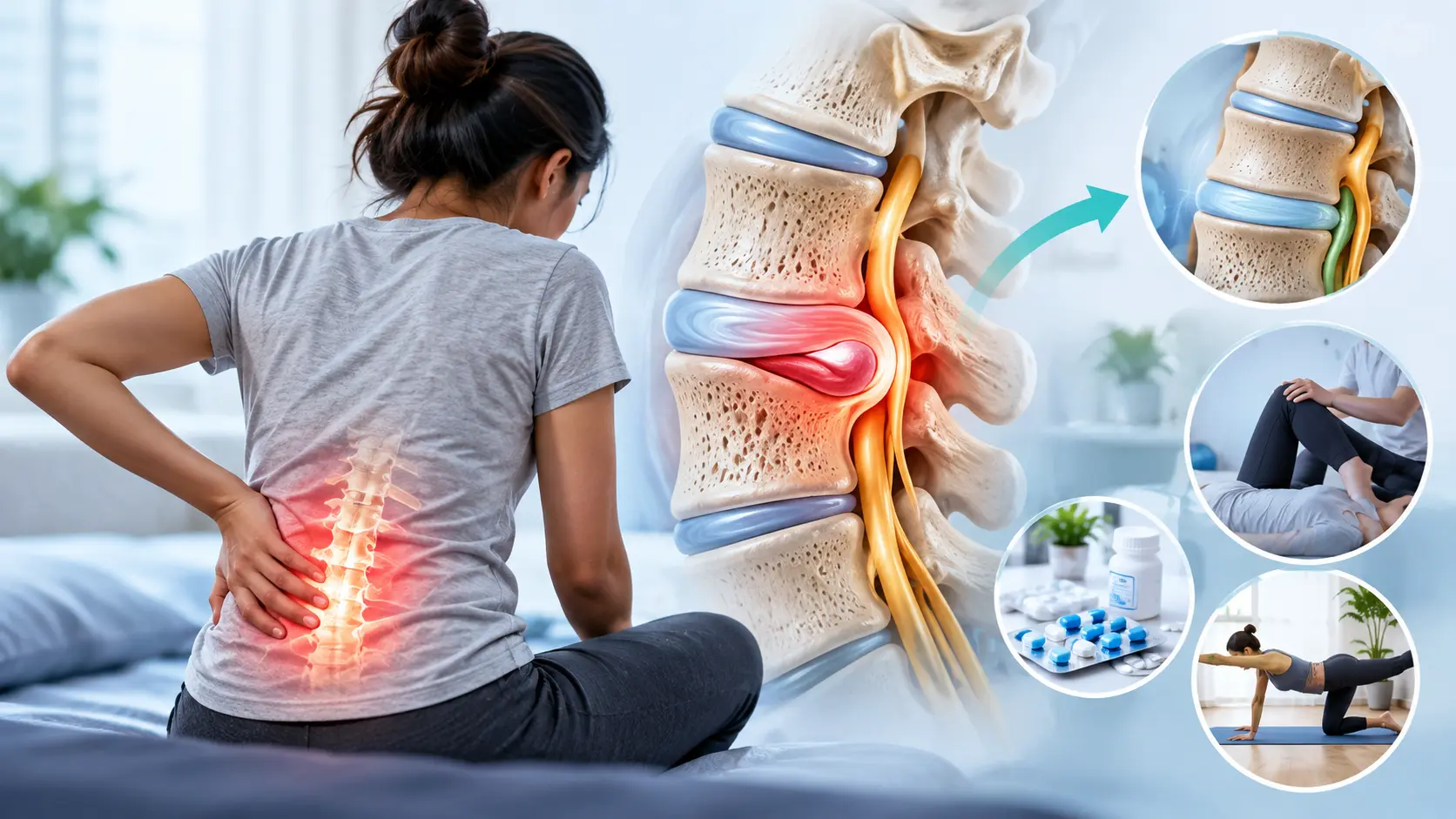
Can disc herniation heal without surgery? In many cases, the body can recover from a herniated disc without an operation. As inflammation settles and pressure around an irritated nerve decreases, symptoms such as back pain, leg pain, tingling, and numbness may gradually improve.
For people in Southfield and the surrounding Metro Detroit area dealing with disc-related pain or sciatica, it helps to understand that recovery is not always immediate. Symptoms can begin easing within weeks, while changes within the injured disc may continue for months.
Can a Herniated Disc Improve Without Surgery?
A herniated disc does not automatically mean surgery will be necessary. Many people begin treatment with nonsurgical approaches that focus on controlling pain, maintaining movement, improving function, and reducing irritation around the affected nerve.
The body may gradually reduce inflammation around the injured area, and portions of displaced disc material can sometimes become smaller over time.
It is also important to separate symptom recovery from structural recovery. A patient may walk more comfortably, experience less leg pain, or regain normal daily function even though imaging still shows evidence of the original disc problem.
Recovery can vary considerably depending on factors such as:
- The location of the affected disc
- The type and size of the herniation
- Whether a nerve root is irritated or compressed
- The severity of neurological symptoms
- Daily activities and work demands
- Overall health and conditioning
- Consistency with rehabilitation
Because every case is different, progress should be judged by symptoms and function rather than by a fixed timetable alone.
How Does a Herniated Disc Recover?
The healing process usually does not involve the disc returning instantly to its original form. Instead, several biological changes may help reduce the effect of the herniation.
Immune response: When displaced disc material becomes exposed outside its normal position, the immune system can respond to it. Certain immune cells help break down the exposed tissue.
Natural resorption: The body can gradually absorb portions of herniated disc material. This process may reduce the amount of tissue occupying space near an irritated nerve.
Loss of fluid within the fragment: Herniated disc material contains water. Over time, it can lose some of that fluid and decrease in volume.
Tissue repair: The damaged outer portion of the disc may develop scar tissue as part of the body's repair process.
A meta-analysis examining spontaneous lumbar disc resorption reviewed 31 studies involving more than 2,200 patients treated conservatively. The researchers reported an overall resorption rate of approximately 70%, with higher rates among sequestrated and extruded herniations.
This is one reason a person's symptoms and physical abilities can improve considerably even when a later MRI does not show a completely unchanged or “normal” disc.
What Does It Mean When a Herniated Disc Heals?
Can disc herniation heal completely? The answer depends on how healing is defined.
For most patients, the practical goal is not necessarily to make an MRI look exactly as it did before the injury. The more meaningful question is whether pain is decreasing and normal function is returning.
Positive changes may include:
- Less back or neck pain
- Reduced radiating pain into an arm or leg
- Decreased numbness or tingling
- Improved strength
- Better tolerance for sitting or standing
- Walking farther without symptoms
- Improved sleep
- Easier performance of work and daily activities
- Greater confidence with movement
Structural changes within the disc can continue long after a person begins feeling better. For that reason, clinical recovery may occur before the full biological process is complete.
Signs a Herniated Disc May Be Healing
The signs herniated disc is healing are not identical for everyone, but certain patterns can suggest that nerve irritation and inflammation are decreasing.
1. Radiating Pain Travels a Shorter Distance
One encouraging change can occur when symptoms that previously extended far down an arm or leg begin affecting a smaller area.
For example, discomfort that once reached the foot may later be felt mainly around the calf, thigh, or buttock. Symptoms extending into the hand may gradually become limited to the upper arm or shoulder region.
Clinicians sometimes refer to this pattern as centralization.
It can be a useful sign when pain consistently moves away from the extremities and closer to the spine.
2. Pain Episodes Become Milder
Recovery can also appear as a change in how often pain occurs and how intense it feels.
You may notice:
- Fewer sharp or shooting episodes
- Shorter flare-ups
- Less pain during ordinary activities
- A shift from severe pain to manageable soreness
- Less need for pain-relief medication
Improvement does not always happen in a straight line. Temporary flare-ups can still occur as activity levels increase.
3. Everyday Movement Becomes More Comfortable
Function is an important marker of recovery.
You may find that you can:
- Walk farther
- Remain seated for longer
- Stand with less discomfort
- Get out of a chair more easily
- Sleep for longer periods
- Complete household or work activities with less guarding
Being able to do more without triggering strong radiating symptoms can be an important indicator of progress.
4. Tingling or Numbness Affects a Smaller Area
Sensory symptoms may improve more slowly than pain because irritated nerves can require additional time to recover.
Improvement may appear as:
- Less frequent tingling
- Reduced intensity of numbness
- Sensation returning to previously numb areas
- Symptoms no longer reaching as far into the foot or hand
If numbness continues to spread or is accompanied by increasing weakness, further evaluation is important.
For more information about nerve-related symptoms, read our guide to pinched nerve symptoms and warning signs.
5. Normal Strength Starts Returning
As pressure and inflammation around a nerve decrease, activities that once felt difficult may gradually become easier.
You might notice improvements in:
- Walking speed
- Balance
- Climbing stairs
- Pushing off with the foot
- Grip strength
- Carrying everyday objects
- Confidence when bending or changing position
Restoring strength is especially important during rehabilitation because feeling less pain does not always mean the body is ready to return immediately to demanding activity.
Can a Slipped Disk Get Better Naturally?
The phrase “slipped disk” is commonly used to describe a disc that has bulged or herniated, although the disc does not actually slide out of its normal position.
Instead, the softer material inside the disc may push outward or pass through a damaged portion of the outer layer.
In many cases, symptoms associated with a slipped disc can become significantly better without surgery. Inflammation around an irritated nerve may settle, and displaced disc material can sometimes shrink as part of the body's natural recovery process.
The length of recovery depends on the severity and location of the injury as well as whether nerve symptoms are present.
Conservative care may include:
- Temporary activity modification
- Gradual return to movement
- Targeted rehabilitation
- Strengthening
- Manual treatment
- Education about lifting and posture
The goal is to restore comfortable function while avoiding unnecessary stress on an irritated area during the early stages of recovery.
Can a Ruptured Disc Heal on Its Own?
A ruptured disc generally describes a herniation in which part of the softer inner material has moved through the disc's outer layer.
Some ruptured or extruded discs can undergo natural resorption.
Interestingly, exposed disc fragments may sometimes be more accessible to the body's immune system than a small contained bulge. This may help explain why some larger extrusions demonstrate substantial reduction over time.
Patients can also experience meaningful symptom improvement before imaging shows complete resorption.
Nonsurgical treatment may therefore be considered when serious neurological deficits are absent.
Surgical evaluation becomes more important when symptoms include progressive weakness, major neurological changes, or persistent disabling pain that does not respond adequately to conservative care.
Herniated Disc Emergency Symptoms: When Should You Seek Immediate Care?
Most disc herniations can be evaluated and treated without emergency intervention. Certain symptoms, however, can indicate severe nerve compression.
Seek urgent medical attention for:
- New loss of bladder control
- New loss of bowel control
- Difficulty emptying the bladder
- Numbness around the groin or inner thighs
- Rapidly worsening leg weakness
- Foot drop
- Difficulty walking because of sudden weakness
- Significant symptoms developing in both legs
- Rapidly progressing neurological changes
The American Association of Neurological Surgeons' guidance on herniated discs also recommends urgent evaluation when significant weakness, loss of sensation around the genital or rectal region, or loss of bladder or bowel control occurs.
Severe back pain accompanied by fever, major trauma, unexplained weight loss, or a history of cancer should also be medically assessed.
Sciatic Pain From a Herniated Disc
A lumbar disc herniation can irritate one of the nerve roots that contributes to the sciatic nerve.
This can produce pain that starts around the lower back or buttock and extends into the thigh, calf, or foot.
People often describe sciatic pain as:
- Burning
- Shooting
- Sharp
- Electric
- Tingling
- Deep aching
Other symptoms can include numbness or weakness in part of the leg or foot.
Disc-related sciatic symptoms may become more noticeable during prolonged sitting, forward bending, coughing, or sneezing.
If sciatica is one of your main concerns, our guide to physical therapy treatment for sciatica explains how strengthening, mobility exercises, nerve movement, and progressive rehabilitation may be used.
During recovery, one encouraging pattern can be pain that no longer travels as far down the leg as it previously did.
Treatment Options That May Support Recovery
Treatment for a herniated disc should be individualized.
Two people can have similar MRI findings but very different symptoms and physical limitations. For that reason, treatment decisions should consider the examination, neurological findings, symptom pattern, activity demands, and response to care.
Activity Modification Without Complete Inactivity
Early in recovery, movements that repeatedly trigger strong radiating symptoms may need to be temporarily reduced.
This can include:
- Heavy lifting
- Repetitive bending
- Prolonged sitting
- Repeated twisting
- Activities that cause symptoms to travel farther down an arm or leg
However, prolonged bed rest is generally not the goal.
When tolerated, short walks, regular position changes, and gentle daily movement can help maintain function while symptoms settle.
The objective is to find a level of activity that does not repeatedly aggravate the condition while gradually rebuilding normal movement.
Chiropractic Care and Spinal Decompression
Chiropractic and rehabilitative approaches may form part of a conservative treatment plan when they are appropriate for the patient's condition.
Chiropractic treatment: Selected techniques may be used to address joint restrictions, mobility limitations, and mechanical factors that contribute to discomfort.
Spinal decompression: Controlled traction may be incorporated for selected patients experiencing certain disc-related or nerve-related symptoms.
At Core Chiro Rehab, spinal decompression in Southfield, MI can be incorporated into an individualized treatment program following an appropriate evaluation.
Soft tissue techniques: Manual or instrument-assisted treatment may be used to address tight or restricted muscles and surrounding soft tissue.
For patients from Southfield and nearby Metro Detroit communities, treatment decisions should be based on the person's actual symptoms and examination rather than relying on a one-size-fits-all protocol.
Physical Therapy and Targeted Exercise
Rehabilitation becomes particularly important as acute pain starts to decrease.
The aim is to restore movement capacity rather than simply avoiding activity.
Depending on the individual, rehabilitation may involve:
Directional movements: Specific movements may be selected according to how the person's symptoms respond.
Nerve mobility exercises: Carefully controlled nerve-gliding movements may be incorporated when appropriate.
Core strengthening: Developing trunk stability can improve the body's ability to manage daily movement and physical demands.
Hip strengthening: Strong hips can support movement around the pelvis and lower back.
Movement retraining: Patients may practice safer and more efficient ways to sit, lift, bend, and perform work-related activities.
Progressive exercise: Exercise difficulty can increase gradually as pain, strength, and mobility improve.
Patients who need supervised rehabilitation can learn more about physiotherapy in Southfield, MI and how individualized exercise and movement-based care may be incorporated into recovery.
Medications and Injections
Medication may be used as part of short-term symptom management.
Depending on the patient's medical history and symptoms, a qualified healthcare professional may consider options such as:
- Anti-inflammatory medication
- Acetaminophen
- Muscle relaxants
- Medication for significant nerve-related pain
For persistent radiating symptoms, epidural steroid injections may sometimes be considered to reduce inflammation around an affected nerve root.
An injection does not put the disc back into its previous shape. Its role is generally symptom control so that movement and rehabilitation can become more manageable.
When Might Surgery Be Needed?
Surgery is not required for every herniated disc.
A surgical consultation may become appropriate when:
- Muscle weakness is severe
- Weakness continues to progress
- Foot drop develops
- Bladder or bowel control changes
- Saddle numbness occurs
- Pain remains severely disabling despite appropriate conservative treatment
- Imaging shows compression that matches significant neurological findings
Imaging should generally be considered together with symptoms and clinical examination rather than being used as the only factor in treatment decisions.
Herniated Disc Recovery Timeline
There is no exact timeline that applies to every patient.
However, recovery can often be viewed in stages.
Weeks 0–2: Managing the Acute Stage
During the early phase, pain and nerve irritation can be prominent.
Treatment may focus on:
- Reducing aggravating activities
- Finding comfortable positions
- Maintaining gentle movement
- Taking short walks when tolerated
- Managing symptoms appropriately
- Watching for neurological warning signs
Some people experience noticeable improvement during this period, while others progress more gradually.
Weeks 2–6: Increasing Comfortable Movement
As symptoms begin settling, patients may notice:
- Less intense radiating pain
- Longer walking tolerance
- Greater sitting or standing tolerance
- Easier daily movement
- Increased ability to perform rehabilitation exercises
This is often when a structured rehabilitation program can begin progressing more consistently.
Weeks 6–12: Rebuilding Strength and Function
As symptoms allow, treatment may focus more heavily on:
- Core strengthening
- Hip strength
- Movement control
- Lifting mechanics
- Work-related activities
- Gradual exercise progression
- Return to hobbies or recreation
The goal is to rebuild the physical capacity required for normal daily life.
Months 3–12: Continuing Recovery
Disc resorption and tissue remodeling can continue over a longer period.
During this time:
- Residual tingling may continue improving
- Strength may continue returning
- Exercise can become more demanding
- Rehabilitation may shift toward prevention
- Occasional symptoms may become less frequent
A person may therefore feel functionally recovered even while biological changes inside the disc are still occurring.
People Also Ask About Herniated Disc Recovery
1. Is a Herniated Disc Lifelong?
Not necessarily.
Some disc changes can remain visible on imaging even when the person has little or no pain.
A previous herniation does not automatically mean lifelong symptoms. Nerve irritation may settle, strength can return, movement can improve, and people may resume normal work, exercise, and daily activities.
Maintaining strength and healthy movement habits can still be useful after symptoms resolve.
2. Can a Herniated Disc Be 100% Healed?
It depends on what you consider complete healing.
Some patients become symptom-free and regain their previous level of activity even though the disc does not return to exactly the same appearance on imaging.
From a functional perspective, being able to work, sleep, exercise, walk, and perform normal activities without significant symptoms may represent a successful recovery.
3. Can I Walk With a Herniated Disc?
Gentle walking is often tolerated by people with uncomplicated disc herniations.
Start with a distance that feels manageable and increase it gradually.
Walking should not be used to push through significant neurological symptoms. If walking causes rapidly increasing weakness, severe pain, or symptoms spreading farther down the leg, seek professional guidance.
4. Is a Herniated Disc a Serious Problem?
Severity varies.
Some people have disc herniations with only mild symptoms, while others experience substantial pain, numbness, weakness, or difficulty with normal activities.
More serious concern is warranted when neurological problems are progressive or when bowel, bladder, or saddle-area symptoms appear.
5. What Is the Fastest Way to Recover From a Herniated Disc?
There is no instant method for repairing a herniated disc.
For people asking whether can disc herniation heal faster with treatment, recovery is usually better approached by reducing repeated irritation and gradually rebuilding normal function.
Helpful strategies may include:
- Staying appropriately active
- Avoiding movements that strongly aggravate symptoms
- Following individualized exercises
- Progressively rebuilding strength
- Improving movement and lifting mechanics
- Managing symptoms appropriately
- Following professional recommendations when neurological symptoms are present
Trying to accelerate recovery with overly aggressive exercise or treatment can sometimes aggravate an already sensitive nerve.
6. What Positions Can Make a Herniated Disc Feel Worse?
The answer varies between individuals.
For some people, prolonged sitting, repeated forward bending, twisting, or heavy lifting can increase symptoms.
The most useful clue is how your body responds. If a position repeatedly causes pain or tingling to travel farther down the arm or leg, it may need to be temporarily modified.
The long-term goal is usually to regain normal movement rather than permanently avoiding everyday positions.
7. Can a Herniated Disc Improve After Several Years?
Long-term symptoms deserve a fresh evaluation.
Changes seen on an old MRI may not always explain current symptoms. Pain years later can involve several factors, including ongoing nerve irritation, joint changes, muscle weakness, reduced mobility, or a new problem.
An updated assessment can help determine whether the original herniated disc remains the main contributor.
8. Can I Live a Normal Life After a Herniated Disc?
Many people are able to return to normal daily activities after a disc injury.
Recovery may involve gradually restoring:
- Strength
- Comfortable movement
- Sitting tolerance
- Walking endurance
- Lifting ability
- Work capacity
- Exercise tolerance
A good rehabilitation plan focuses not only on reducing pain but also on rebuilding the physical capacity needed for everyday life.
Herniated Disc Care in Southfield, MI
At Core Chiro Rehab in Southfield, Michigan, we provide individualized nonsurgical care for patients experiencing disc-related back pain, sciatica, nerve irritation, stiffness, and mobility limitations.
Depending on your examination findings and symptoms, your care plan may incorporate chiropractic treatment, spinal decompression, physiotherapy, soft tissue techniques, targeted exercises, and movement education.
We also look at factors that may influence recurring symptoms, including prolonged sitting, lifting habits, work posture, exercise technique, and general movement patterns.
For patients in Southfield and nearby Metro Detroit communities, the objective is not simply temporary pain reduction. Treatment should help you move more comfortably, rebuild strength, improve day-to-day function, and return progressively to the activities that matter to you.
If disc-related symptoms are interfering with your sleep, work, driving, exercise, or everyday movement, an evaluation can help determine what structures may be involved and what type of conservative care may be appropriate.
Book your consultation today for an individualized assessment and recovery plan based on your symptoms, mobility, and functional goals.