



Quick answer: Cervicogenic headache treatment goes after the real culprit: sore joints and tight muscles in the upper cervical spine. Research favors a combination of manual therapy and a brief daily exercise routine, supported by smarter desk and sleep habits. Gains usually come gradually over several weeks, and a doctor may layer in medicine or an injection if progress stalls.
You wake up fine, sit at your laptop all morning, and by lunch a dull ache has crept from the back of your neck to the side of your head. If that sounds familiar, here is what's happening, how it's treated and when to worry.
Cervicogenic Headache Symptoms: Is Your Neck the Source?
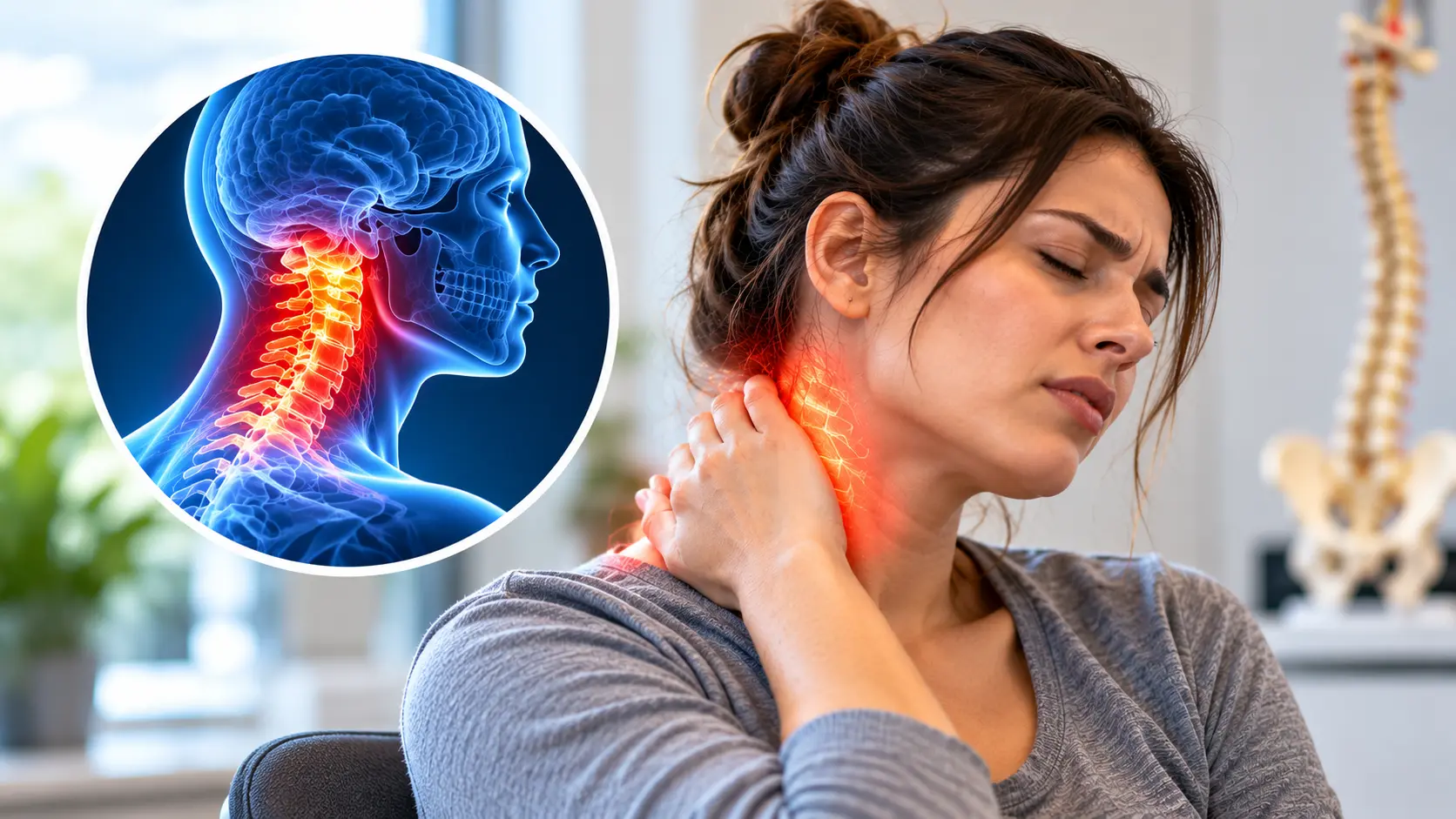
A neck-driven headache leaves a few fingerprints. Look for these cervicogenic headache symptoms:
- The pain picks one side and sticks with it
- It starts low on the neck, then fans out to the temple, eyebrow or eye socket
- It feels like deep, dull pressure rather than a pounding pulse
- Turning your head toward that side feels restricted
- A firm press on one spot below the skull switches the ache on
- The matching shoulder or arm may ache as well
- Nausea or glare sensitivity may appear, though usually mildly
In short, the headache takes its cues from your neck. Posture, movement and pressure all change how it feels.
Try this two-minute neck check
Sit tall and slowly turn your head left, then right. Notice whether one direction stops sooner. Next, press gently along the ridge under your skull on the painful side. If the turn is shorter and the pressure brings back your familiar headache, share both findings with your clinician. It isn't a diagnosis, but it's useful information.
Can Neck Pain Cause Headaches? Here's the Wiring Behind It
It can. Sensory nerves from the first three cervical levels (C1, C2 and C3) feed into a cluster of brainstem cells called the trigeminocervical nucleus. That same cluster processes input from the trigeminal nerve, the face's main sensory nerve. Since the brain receives both inputs at one address, it sometimes pins pain from an upper neck joint on the head. Medical texts call this referred pain.
That's why a cervicogenic headache is classed as secondary: the head pain is a symptom, and the neck is the cause. It's uncommon before age 30 and shows up more often in people with an old neck injury or a desk-heavy job.
Cervicogenic Headache, Migraine or Tension Headache: How to Tell
These three overlap, so the details matter:
- Cervicogenic headache: one-sided, starts in the upper neck, steady and dull, brought on by neck movement or a held posture, with reduced rotation.
- Migraine: often pulsing, may switch sides, can come with nausea and a strong dislike of light and sound, and may last 4 to 72 hours without treatment.
- Tension-type headache: a band of pressure on both sides, usually linked to stress and tight muscles, with normal neck movement.
Migraine neck pain adds a twist. Neck stiffness can show up in the day or two before a migraine, so neck soreness by itself can't settle which headache you have. A hands-on exam can.
What Leads to Headaches Due to Neck Problems?
Most headaches due to neck problems grow out of one of these:
- Injury: a car collision or fall that strains the upper neck, sometimes with symptoms appearing days later
- Joint wear: arthritis in the top neck joints
- Disc or nerve irritation: inflammation around the C2 or C3 level
- Sustained positions: long laptop sessions, phone scrolling, reading in bed or long drives
- Sleep setup: a pillow stack that's too tall, or sleeping with your head twisted
Office days followed by a Southfield commute make a tough pairing: hours of leaning toward a screen, then more time with the head turned for traffic. For desk and phone fixes, see our tech neck guide.
What Happens at a Cervicogenic Headache Exam?
Diagnosis is clinical, meaning it relies on your history and a physical exam rather than one lab result. Expect your provider to:
- Ask about the headache's starting point, its triggers and how often you rely on pain relievers
- Perform the flexion-rotation test, turning your head side to side while your chin rests on your chest, which isolates the C1–C2 joint
- Apply pressure to specific neck joints and muscles to find out if your typical headache can be reproduced
- Request imaging, such as an X-ray, only when something hints at a different problem
If the source is still unclear, a physician may numb one joint or nerve in the neck. When the headache eases afterward, the diagnosis is confirmed.
Cervicogenic Headache Treatment Options, Step by Step
Care usually builds in layers. Cleveland Clinic reports a study where 72% of participants saw headache frequency fall by at least half one year into physical therapy, which is why rehab sits at the center of most plans.
- Calm the flare. Heat, gentle movement and short breaks from whatever position sparked the pain.
- Restore joint motion. Mobilization or chiropractic adjustments to loosen locked-up segments in the upper neck.
- Rebuild support. Deep neck flexor and shoulder blade exercises so the neck stops overworking.
- Add medical options if needed. Prescription medication, nerve blocks or, for stubborn cases, radiofrequency ablation, all managed by a physician.
Cervicogenic headache physical therapy
In cervicogenic headache physical therapy, the star exercise is craniocervical flexion: a small, controlled nod done lying down that wakes up the deep flexor muscles in the front of your neck. Around it, therapists build in hands-on joint work, muscle release and, later, shoulder and upper back strengthening. Symptoms can tick up briefly in the first sessions, so the program is paced with care. Core Chiro Rehab offers physical therapy in Southfield, MI built around this progression.
Chiropractic care for cervicogenic headaches
A chiropractor adds precise joint work to the plan, using adjustments or low-force mobilization depending on what suits you. Every plan starts with a screening exam, and serious complications from neck adjustments are rare. Pairing joint work with home exercise is the combination research supports. Learn about chiropractic care in Southfield.
A word on pain relievers
Ibuprofen, naproxen and acetaminophen can soften a flare, but they don't address the neck. Relying on them on 15 or more days each month over a long stretch can backfire into rebound headaches, so check with your doctor or pharmacist about safe use.
A 10-Minute Daily Routine for Cervicogenic Headache Relief
Get your provider's go-ahead first. Work slowly, and stop if the headache worsens or if dizziness or arm tingling appears.
- Lying chin nod. Settle onto your back with knees bent and a thin towel folded beneath your head. Make the smallest possible yes motion, keeping your head resting on the towel. Aim for ten holds of ten seconds, morning and evening.
- Seated chin tuck. From a tall seated position, pull your chin backward in a straight line with your eyes level. Aim for ten 5-second holds, three times daily.
- Shoulder blade setting. Draw both shoulder blades a little toward your spine and down toward your waist. Aim for two rounds of ten 5-second holds.
- Towel-assisted neck rotation. Loop a hand towel around the top of your neck, holding both ends in front. Rotate gently toward the tight side and let the towel steer the motion. Aim for three 3-second holds, twice daily, after a clinician shows you the grip.
Small Changes at Home That Help
- Apply a heating pad to tight neck and upper back muscles, 15–20 minutes at a time
- Raise your screen so you aren't looking down
- Set a timer to stand and move every hour
- Sleep on a pillow that holds your head neutral, not propped or sagging
- Avoid soft collars and home traction devices unless your provider approves them
- Log each headache for a couple of weeks before you come in
Red Flags: When to Call 911
Get emergency help right away when head pain arrives alongside any of the following:
- A sudden, explosive onset
- A recent head injury or collision
- Fever plus neck stiffness, a rash or mental confusion
- Arm or leg weakness, numbness, seeing double or garbled speech
- Passing out or having a seizure
Make a prompt appointment with a doctor if headaches are getting steadily worse, or if a brand-new type appears after 50.
Cervicogenic Headache Treatment in Southfield, MI
Here's how care works at Core Chiro Rehab:
- Assessment: we review your history, screen for warning signs, test how your neck moves and use on-site digital X-rays if needed.
- Care: your plan may blend adjustments or mobilization, Active Release Technique and other soft-tissue therapy, home exercises and desk setup tips.
- Referral: findings that suggest a medical issue get passed to an appropriate physician.
Same-day appointments are often available, and Saturday morning slots help if weekdays are packed. Most major insurance plans are accepted, and so is all auto insurance. Book online or call (248) 327-6931. We're at 17070 W 12 Mile Rd, Suite B, Southfield, MI 48076.
Cervicogenic Headache Treatment FAQs
How effective is cervicogenic headache treatment?
Manual therapy combined with targeted exercise has good research support, and many people notice fewer, milder headaches within weeks. Results vary, so your provider will reassess progress along the way.
How many sessions does cervicogenic headache physical therapy usually take?
A typical program spans roughly six weeks with one to two sessions weekly. Long-standing or post-injury cases may need more time.
Does chiropractic care work for neck-related headaches?
It can. Adjustments or mobilization improve upper neck movement, and pairing them with exercise is the approach research supports for cervicogenic headaches.
Chiropractor or physical therapist: who should treat a cervicogenic headache?
Either can help, since both use joint work and exercise. A clinic that offers both lets you combine them in one plan.
Which pain relievers are safe for cervicogenic headache flare-ups?
Ibuprofen, naproxen or acetaminophen may help short term if they're safe for you. Ask a doctor or pharmacist, and limit use to fewer than 15 days per month.
When do doctors recommend nerve blocks for cervicogenic headaches?
Usually when the source is unclear or pain doesn't respond to rehab. The injection can confirm the diagnosis and give temporary relief.
Which pillow works best for cervicogenic headache relief?
A pillow that holds your neck in a neutral line: fuller if you sleep on your side, flatter if you sleep on your back. Stomach sleeping is best avoided.
Is a telehealth appointment enough to diagnose a cervicogenic headache?
Not on its own. Virtual care can cover your history, but the diagnosis needs an in-person neck exam.
Why does a cervicogenic headache cause pain behind one eye?
Nerves from the upper neck share a brainstem relay with the nerve supplying the area around the eye, so neck pain can register there.
Does insurance cover cervicogenic headache treatment in Southfield, MI?
Coverage depends on your plan. We take most major insurers plus all auto insurance; call (248) 327-6931 and we'll confirm your benefits.
The Bottom Line
Cervicogenic headaches start in the neck, so relief usually comes from treating the neck: a clear diagnosis, hands-on care, a short daily routine and better habits at your desk and in bed. When your headaches track with neck strain, book a visit with our Southfield team.