



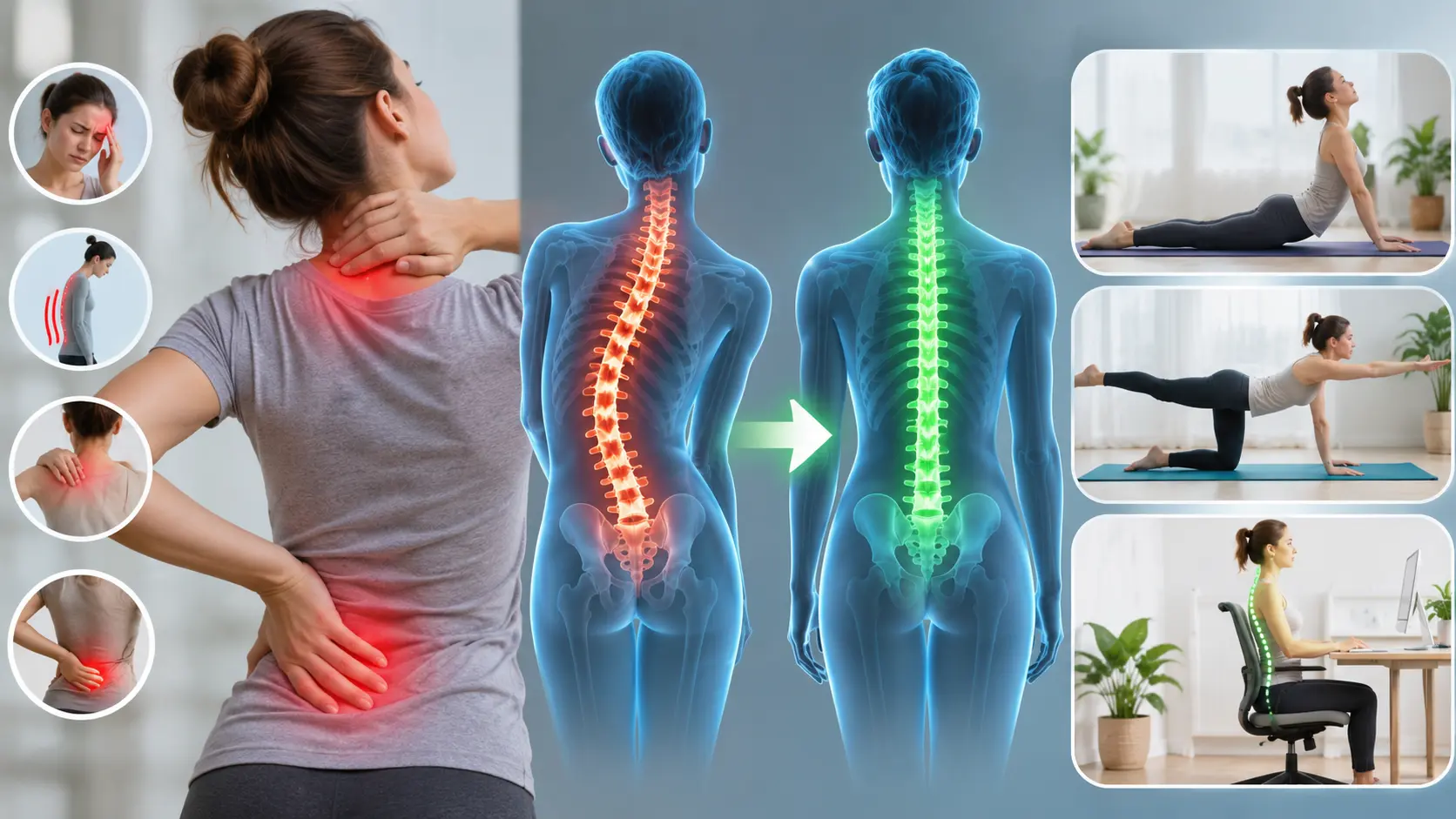
Quick answer: Healthy spinal alignment means your spine keeps its three natural curves, at the neck, mid-back and lower back, stacked evenly over your pelvis. Most “out of alignment” feelings come from stiff joints and tight, guarding muscles, not a bone out of place. Gentle movement, targeted exercise, better daily habits and hands-on care when needed usually help.
If your back feels crooked, locked or just “off,” you’re not imagining it. The feeling is real, even if the explanation is different from what you’ve heard. Here’s what’s actually happening, which signs matter, what you can safely do at home and when to see a professional.
Feeling stuck right now? At Core Chiro Rehab in Southfield, MI, every first visit starts with a hands-on exam to find out whether you’re dealing with a stiff joint, a guarding muscle or something that needs imaging. If it’s a good fit, our chiropractic care pairs gentle adjustments with simple exercises you can keep doing at home.
Is Back Misalignment Real?
Not in the way most people picture it. Each bone in your spine is held firmly by tough ligaments, cushioning discs and layers of muscle, so everyday bending, lifting and twisting don’t knock a vertebra loose.
Structural problems do exist, though. Scoliosis is a sideways curve, kyphosis is an extra-rounded upper back and spondylolisthesis is when one vertebra slides forward over the one below it. These are diagnosed with an exam and imaging, and they’re different from the vague “off” feeling most people describe.
When chiropractors talk about a misalignment or “subluxation,” they usually mean a spinal joint that isn’t moving as freely as it should. That stuck feeling is most often tight muscles protecting a sore area, joints that have been still too long or an irritated nerve. All of these can be treated.
Is Your Spine Supposed to Be Straight or Curved?
Both, depending on where you look. From behind, a healthy spine runs in a fairly straight line from the base of your skull to your tailbone. From the side, it forms a gentle S-shape with three curves:
- Neck (cervical spine): a gentle inward curve
- Mid-back (thoracic spine): a gentle outward curve
- Lower back (lumbar spine): another inward curve
These curves work like a spring, spreading the load every time you walk, climb stairs or carry groceries. That’s why good spinal alignment is never meant to be ruler-straight from the side.
What a Healthy Spine Looks Like When Standing
A rough guide: your ear sits over your shoulder, your shoulder over your hip and your hip over your ankle. Bodies vary, and plenty of people with a deeper lower-back curve or rounder shoulders never have pain. What matters more than any single pose is a spine that moves easily and has enough muscle support.
Misaligned Vertebrae Symptoms: How to Tell If Your Spine Is Out of Alignment
People who feel their back is “out” usually notice a handful of familiar signs:
- Stiffness, especially first thing in the morning or after sitting
- Pain or tightness on one side of the spine
- A catching or locked feeling when you twist or bend
- Reduced range of motion in your neck or lower back
- Shoulders, hips or waistline that look uneven in a mirror
- Headaches that start at the base of the skull
- Numbness or tingling in an arm or leg (get this checked promptly)
None of these proves a bone has moved; they also show up with muscle strain, joint irritation and disc problems. They do tell you something in your back needs attention.
What Causes Back Misalignment?
- Long hours of sitting, especially slumped at a desk or in the car
- “Text neck” from looking down at a phone or laptop
- Lifting with poor form, such as rounding your back or twisting under load
- Injuries from falls, sports or car accidents
- Muscle imbalances, like weak glutes and core muscles or tight hip flexors
- Stress, which tightens the muscles on either side of the spine
Why Lower Back Alignment Feels Off First
Your lower back carries the most load, so it’s usually the first place to complain. Long sitting shortens the muscles at the front of your hips and tips the pelvis forward. Lift a heavy box on Saturday and you may stand slightly lopsided by Monday. Nothing slid out of place; the muscles beside your spine clamped down to protect it, and that tightness is what feels crooked.
A 2-Minute Self-Check
These quick checks give you clues, not a diagnosis.
- Wall test: Stand with your heels, buttocks and shoulder blades against a wall. Notice whether your head rests on it comfortably.
- Mirror check: Look for a clear tilt in your shoulders or hips. Small differences are normal.
- Forward bend: Have someone watch as you bend forward. A bump on one side of the ribs can signal scoliosis and needs a medical exam.
- Movement check: Note which direction feels stiff: bending, leaning back, twisting or side-bending.
What Happens When Your Neck Is Out of Alignment?
When your neck stiffens or your head drifts forward, you may notice tight shoulders, a neck that won’t turn fully or headaches that start at the base of the skull. The load adds up fast. A 2014 computer-model study by spine surgeon Dr. Kenneth Hansraj estimated that an adult head weighs about 10 to 12 lb in a neutral position, but the force on the neck rises to about 27 lb at a 15-degree forward tilt and about 60 lb at 60 degrees.
Raising your screen to eye level, taking breaks from your phone and doing chin tucks can ease that strain. Tingling, numbness or weakness in an arm or hand is different: it can mean an irritated nerve and should be evaluated.
How to Realign Your Spine at Home: 8 Safe Steps
You can’t push vertebrae back into place yourself, but you can restore movement, strength and comfort. Follow these steps in order:
- Check for red flags. If any warning sign listed below applies, get medical help first.
- Walk daily. Aim for 10 to 20 minutes a day and change positions often. Long stillness tightens a stiff back further.
- Do cat-cow. On hands and knees, slowly arch and round your back for 8 to 10 rounds.
- Add chin tucks. Gently draw your chin straight back, hold for 3 seconds and repeat 10 times.
- Do glute bridges. Lying on your back with knees bent, lift your hips for 2 sets of 12.
- Practice bird dogs. On hands and knees, extend the opposite arm and leg, hold for 5 seconds and do 6 per side.
- Stretch your hip flexors. Hold a kneeling hip flexor stretch for 30 seconds, twice on each side.
- Reset your setup. Keep your screen at eye level and your feet flat on the floor, and stand up or move every 30 minutes.
Stop any exercise that causes sharp pain, tingling into a limb or dizziness. For a plan built around your body, our physiotherapy team can coach you through the right exercises and progress them safely.
Why Cracking Your Own Back Isn’t the Fix
That satisfying pop feels like something clicked into place, but the sound most likely comes from gas shifting inside joint fluid. Relief is short-lived because the cause hasn’t changed. Repeated forceful twisting can irritate joints and ligaments, and hard neck cracking carries rare but serious risks. Treat the urge to crack as a sign the area is stiff, and choose slow, controlled movement instead.
Daily Habits That Protect Spinal Alignment
- Vary your position. Your best posture is your next one.
- Lift smart. Hold loads close and bend at your hips and knees instead of rounding your back.
- Build strength twice a week. Glutes, abdominals and upper-back muscles give your spine backup.
- Sleep supported. Side sleepers can put a pillow between the knees; back sleepers can place one under the knees.
- Manage stress. Short walks and slow breathing ease shoulder and back tension.
What a Chiropractor Can and Can’t Do for Spine Alignment
A good chiropractor starts with your history and a hands-on exam, checking how you move and screening for anything more serious. Care may include gentle adjustments or joint mobilization, soft tissue work, targeted exercises and practical advice on posture and daily habits. Learn more about how chiropractic adjustments help with back and neck pain.
Set realistic expectations. Adjustments can ease pain and help stiff joints move more freely, but they don’t permanently reshape a healthy spine. A good plan has clear goals and regular progress checks, not a long, fixed package of visits.
Can a Digital X-Ray Show Spinal Misalignment?
Yes, for structural changes such as a scoliosis curve, a slipped vertebra, disc space narrowing, arthritis or changes in your neck or lower-back curve. It can’t show muscle tension, and most back pain doesn’t need imaging. At Core Chiro Rehab, imaging is used when the exam points to a likely structural issue or injury, and our in-office digital X-ray means images can usually be reviewed with you the same visit.
When to See a Doctor Right Away
Most back stiffness isn’t dangerous, but get urgent medical care if you notice:
- Trouble controlling your bladder or bowels
- Numbness in the groin, buttocks or inner thighs
- Leg weakness that’s quickly getting worse
- Back pain after a fall, car accident or other injury
- Fever, unexplained weight loss or a history of cancer along with back pain
- Severe pain at night that doesn’t ease when you change position
A teenager with a visibly uneven back should also see a physician, since scoliosis is best assessed early.
Spinal Alignment Treatment in Southfield, MI
Still stuck after a week or two of gentle movement? Here’s what to expect at Core Chiro Rehab:
- Assessment: A conversation about your symptoms, a hands-on movement exam and digital X-ray only if it’s needed.
- Care: A plan that may combine chiropractic adjustments, physiotherapy, soft tissue work and home exercises, reviewed regularly.
- Referral if needed: If anything points to a medical condition, we’ll refer you to a physician or specialist.
Same-day appointments are often available. Book online or call (248) 327-6931. We’re at 17070 W 12 Mile Rd, Suite B, Southfield, MI 48076, open Monday through Thursday 8:30 AM to 6 PM, Friday 8:30 AM to 3 PM and Saturday 9:30 AM to 1:30 PM.
Frequently Asked Questions
What Are the Most Common Misaligned Vertebrae Symptoms?
Common signs include stiffness, one-sided back or neck pain, a locked feeling when twisting, uneven shoulders or hips and headaches that start at the base of the skull. These signs usually come from tight muscles or stiff joints rather than a bone out of place.
Is Healthy Spine Alignment Straight or Curved?
Both. From behind, a healthy spine looks fairly straight. From the side, it has three gentle curves at the neck, mid-back and lower back that work like a spring to absorb load.
Can Spine Alignment Be Improved at Home Without a Chiropractor?
Often, yes. Walking, cat-cow, chin tucks, glute bridges and better desk habits can restore movement and ease stiffness. Home exercises can’t move vertebrae back into place, so pain that lasts beyond a couple of weeks deserves a professional exam.
Can a Digital X-Ray Show Spinal Misalignment?
A digital X-ray can show structural issues such as scoliosis, a slipped vertebra or changes in the spine’s natural curves. It can’t show muscle tension, and most back pain doesn’t need imaging unless there’s an injury or a warning sign.
How Many Chiropractic Adjustments Are Needed to Realign the Spine?
There’s no set number. Many people with a recent flare-up notice a change within a few visits, while long-standing stiffness can take 6 to 12 weeks combined with home exercise. Progress should be reviewed regularly.
Why Does Back Misalignment Keep Coming Back After an Adjustment?
Adjustments ease stiffness and muscle tension for a while, but the habits behind them, such as long sitting or weak core muscles, often remain. Daily movement and strengthening exercises help results last longer.
Is Chiropractic Care for Spine Alignment Safe in the First Trimester?
Many people receive chiropractic care in early pregnancy when the chiropractor uses pregnancy-adapted techniques and avoids pressure on the abdomen. Check with your OB-GYN or midwife first, and wait for clearance if you have bleeding, cramping or a high-risk pregnancy.
Can Back Misalignment Cause Headaches?
Neck stiffness and tight upper-back muscles can contribute to headaches that start at the base of the skull. Neck exercises and hands-on care may ease them for some people. A sudden, severe or unusual headache needs a doctor right away.
Does Cracking the Back at Home Realign the Spine?
No. The pop comes from gas shifting in joint fluid, not a bone moving back into place. Relief is brief, and repeated forceful twisting can irritate joints. Slow stretches or a professional exam are better options.
What Sleeping Position Is Best for Lower Back Alignment?
Side or back sleeping usually works best. Side sleepers can place a pillow between the knees, and back sleepers can place one under the knees. Stomach sleeping often arches the lower back and twists the neck.
The Bottom Line
Good spinal alignment isn’t about forcing bones back into place or holding one perfect pose. It’s about a spine that moves freely and has strong muscles supporting it. Most “off” feelings are stiffness and muscle guarding, and they usually respond to gentle movement, simple strengthening and better habits. If your back still feels stuck after a couple of weeks, book an appointment at Core Chiro Rehab in Southfield for a hands-on assessment.
Sources: Hansraj KK, Surgical Technology International, 2014 (PubMed 25393825); Mayo Clinic: Back Pain; Mayo Clinic: Chiropractic Adjustment; NIAMS (National Institutes of Health): Back Pain.
This article is for general education, not a diagnosis. Talk to a licensed healthcare provider about your symptoms.